 Written and reviewed by the A-Z Landscaping Design-Build Team Richmond Hill, ON12+ years · 380+ projectsUpdated June 14, 2026
What an interlock driveway really costs in Toronto and Vaughan in 2026 — installed square-foot ranges, what drives the price, how Toronto lots differ from Vaughan estate driveways, and why interlock outlives concrete in our freeze-thaw climate.
Your driveway is the single largest hardscape surface on your property and the first thing anyone sees. It is also the hardest-working — it takes vehicle loads, road salt, snowplows, and roughly forty freeze-thaw cycles a year in the GTA. So when a homeowner in Woodbridge or the Danforth asks what an interlock driveway costs in 2026, the honest answer starts with what is going under it. Here are the real numbers.
2026 installed price ranges
For the Toronto and Vaughan market in 2026, an interlock driveway installed properly runs roughly $20 to $45+ per square foot. Translated into whole projects:
- Single driveway (roughly 500–800 sq ft): $15,000 – $30,000. Standard-to-mid paver, straightforward access, one border course, normal excavation.
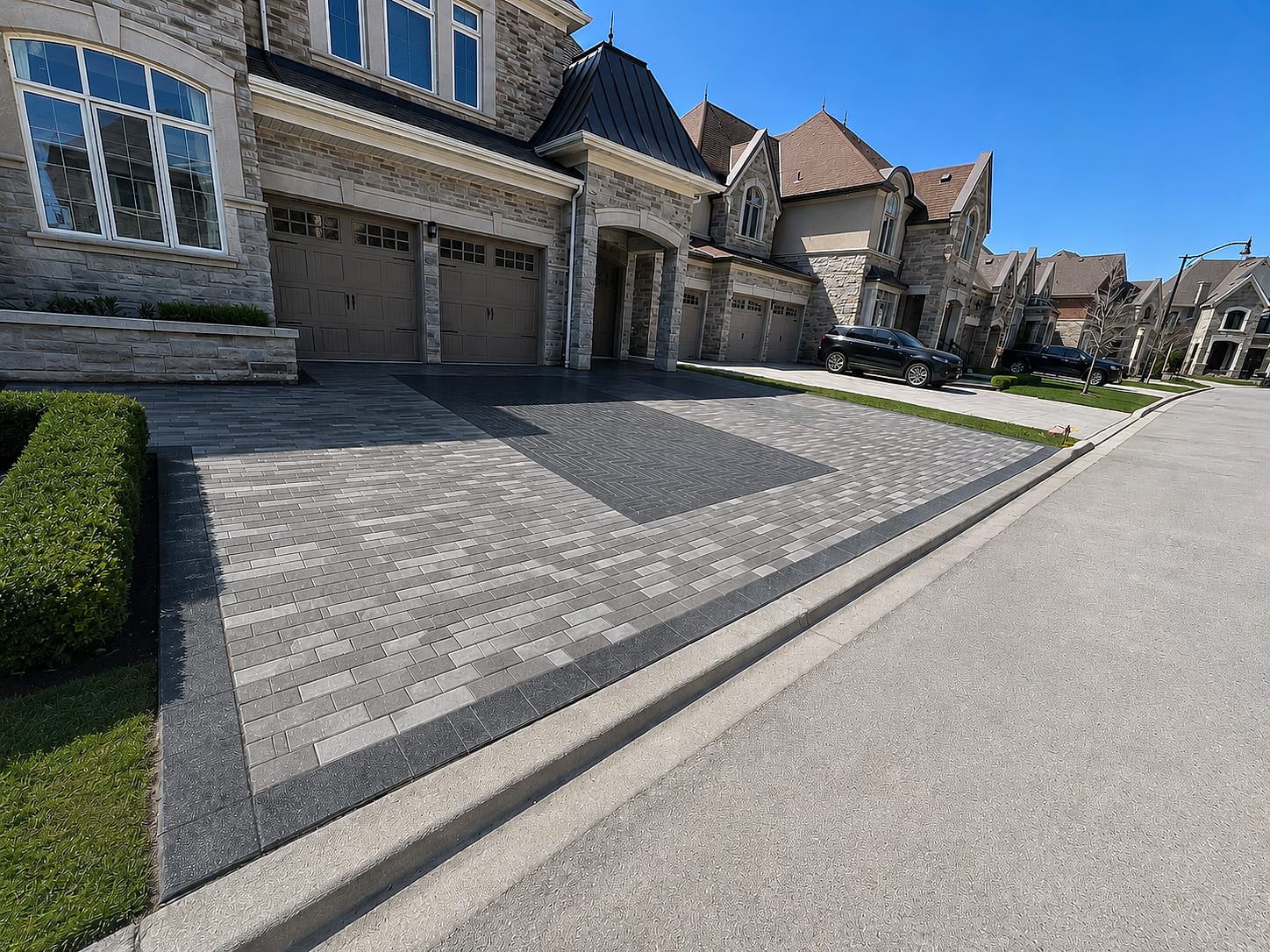
- Double or estate driveway (1,200–2,500+ sq ft): $30,000 – $80,000+. Larger footprint, premium or large-format pavers, banding and feature borders, turnaround or parking court, deeper base, meaningful excavation and disposal.
- Above $80,000: circular estate drives, heated systems, natural stone, significant grade correction, or extensive drainage engineering.
Where you land inside $20–$45/sq ft is not random. Below is exactly what moves it.
What drives the price
Paver choice
Roughly a $6–$14/sq ft swing on its own. A standard rectangular paver is the value option and still performs well. Premium lines from Unilock and Techo-Bloc — with through-colour or surface technologies that resist fading and salt scarring — cost more and look considerably better in year ten. Large-format slabs are the top tier: fewer joints, a cleaner modern look, but they are heavy, demand a flatter, more meticulous base, and carry higher installation labour. On a driveway, verify the unit is rated for vehicular load. Not every attractive paver is.
Base depth and load rating
This is where quotes quietly diverge. A backyard patio can live on 8 inches of compacted granular. A driveway cannot. Vehicles are a different load case, and our clay subsoils across much of the GTA hold water and heave. We build driveway base at roughly 12–18 inches of granular A, compacted in lifts, over geotextile fabric on soft or clay-heavy subgrade. If a quote is dramatically cheaper than the rest, the base is almost always the reason — you cannot see 6 inches of missing gravel from the porch, but your driveway will show you in three winters.
Excavation and disposal
Going 12–18 inches down over 1,500 sq ft means a lot of material leaving your property. Trucking and tipping fees in the GTA are real money, and if the removed material is old asphalt or tests as contaminated fill, disposal costs climb again. This line item scales directly with area and depth.
Site access
Driveways are usually the most accessible part of a property, which helps — but not always. Narrow older Toronto streets with no place to stage a bin, permit parking, shared mutual drives, and tight turns for a delivery truck all add labour hours. Estate lots in Vaughan are typically the opposite: machines drive right in, and efficiency shows up in the price.
Borders, banding and aprons
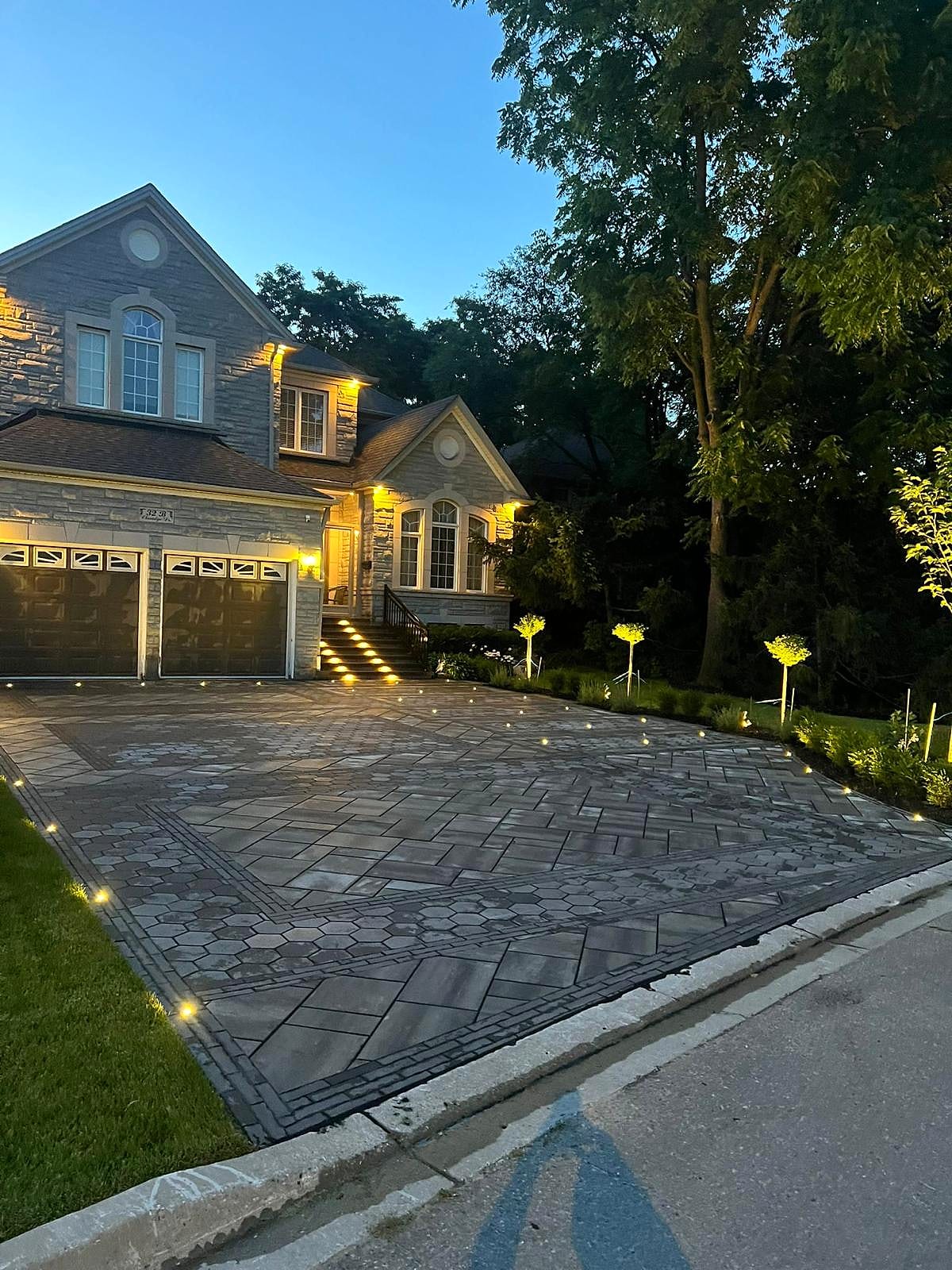
Design detail costs cutting time. A soldier course border, contrasting double banding, a feature apron at the garage, or a curved edge all mean more saw work, more waste and more layout labour. It also transforms how the driveway reads from the street — this is generally money well spent, but know that it is a real line item, not a free flourish.
Drainage and grading
Every driveway must move water away from the garage and the foundation. Sometimes that is achieved with a simple pitch. Sometimes it needs a trench drain across the garage entry, catch basins, or a permeable paver section — genuinely useful on lots where water has nowhere else to go. Where a grade change meets the driveway edge, you may also need retaining walls or steps and entrances to tie it all together.
Heated driveways
Electric or hydronic snow-melt loops installed within the base. Expect roughly $12–$25 per square foot on top of the driveway cost, plus electrical or boiler work, and factor in operating cost. On a steep drive, or for anyone who is done with shovelling, it is a legitimate luxury. It must be designed in from day one — it cannot be retrofitted without a full rebuild.
Permits and city sidewalk tie-ins
The apron between your property line and the road usually belongs to the municipality. Toronto and Vaughan both have their own rules for driveway widening, boulevard work, curb cuts and sidewalk crossings, and each carries application fees and lead time. Widening a driveway is frequently a permit matter, not just a construction one. We handle these applications, but they belong in your schedule and your budget from the start.
Toronto vs Vaughan: why the same driveway prices differently
These are two genuinely different markets sitting 20 minutes apart.
- Toronto. Older lots, narrower drives, mutual driveways, mature street trees with protected root zones, and frequently no room to stage material or park a bin. Footprints are smaller so totals are lower, but cost per square foot trends to the high end because of access, tree protection and permit complexity. Many downtown driveways also sit over decades of mixed fill that has to come out.
- Vaughan. Larger lots, wider drives, and the estate driveways of Kleinburg and Woodbridge — parking courts, circular drives, 2,000+ sq ft of surface, feature banding and often a matching walkway and entrance. Per-square-foot rates can be more efficient because machines have room to work, but total project size drives the number up. Estate drives are where large-format pavers and heated systems most often appear. See driveways in Vaughan for what we build locally.
Replacing failing asphalt or concrete
Most of our driveway work is replacement, not new construction. Asphalt in the GTA typically gives 12–18 years before it is cracking, ravelling and pooling. Poured concrete cracks — not if, but where and when, because our freeze-thaw cycle plus road salt attacks the surface, and control joints only suggest where the crack should go.
When we remove an old driveway we almost always find the same story: an inadequate base. So the honest advice is that you are not paying to swap a surface, you are paying to rebuild the structure underneath it and finish it with a surface worth the effort. Budget accordingly — and be suspicious of anyone who offers to lay pavers directly over your existing concrete or asphalt.
Lifespan and repairability vs concrete
This is where interlock earns its price:
- Movement. Interlock is a flexible pavement. Thousands of small units with sand joints let the surface flex through freeze-thaw instead of cracking. Concrete is rigid — it has no choice but to crack.
- Repairability. If a utility crosses your drive, or one small area settles, we lift the affected pavers, correct the base and reset them. The repair is invisible. A concrete repair is a patch you will see forever, and a colour match that never quite matches.
- Lifespan. A correctly built interlock driveway with proper base and drainage should give 30+ years with occasional joint sand top-up. Concrete typically shows real deterioration at 15–25 years in our climate.
- Salt. Premium pavers handle de-icing salt far better than a concrete surface, where salt attacks the finish and causes spalling.
We put the full head-to-head — cost, appearance, maintenance, resale — in our in-depth Interlock vs Concrete Driveways comparison. If you are still deciding between surfaces, read that before you spend a dollar. If concrete is genuinely the right call for your project, we build that too — see concrete. We would rather tell you the truth than sell you the wrong product.
Questions we hear every week
Will an interlock driveway sink?
Not if the base is right. Settling is a base failure, not a paver failure. Correct depth, compaction in lifts, geotextile where needed and functioning drainage — get those right and it stays flat.
Do weeds grow in the joints?
Polymeric sand largely handles this. Anything you do see is windblown seed sitting on the surface, not growth from below. A top-up every several years keeps the joints tight.
How long does the install take?
A typical single driveway is about 3–5 working days. A large estate driveway with banding and drainage detail can run 2–3 weeks. Permits, when required, sit ahead of all of it.
Can I do the driveway and walkway together?
You should. Same crew, same mobilization, same material lot — and a driveway that flows into a matching walkway, entrance and front-yard design reads as one property instead of three decisions. Pair it with interlocking patios and landscape design-build for a cohesive result. Verifying that any contractor you consider is a legitimate, accountable business is easy through Landscape Ontario.
How to get a fixed quote
Per-square-foot ranges are for budgeting. A real number needs someone standing on your driveway: measuring, checking your grade, testing what is under the existing surface, confirming access, and identifying whether the city apron is in play. Then we model it in photoreal 3D so you see the paver, the banding and the finished look before anything is torn out — and we issue a fixed, itemized quote that names the base depth, the paver, the drainage detail and the warranty. In-house crews. Multi-year workmanship warranty. No mid-job surprises.
See finished work in our project gallery and our Vaughan resort backyard case study, or read how to choose a GTA landscaping contractor before you compare bids. When you want an exact number for your property in Toronto, Vaughan, Richmond Hill or anywhere in the GTA, explore our driveways service or get a free estimate and we will measure it properly.