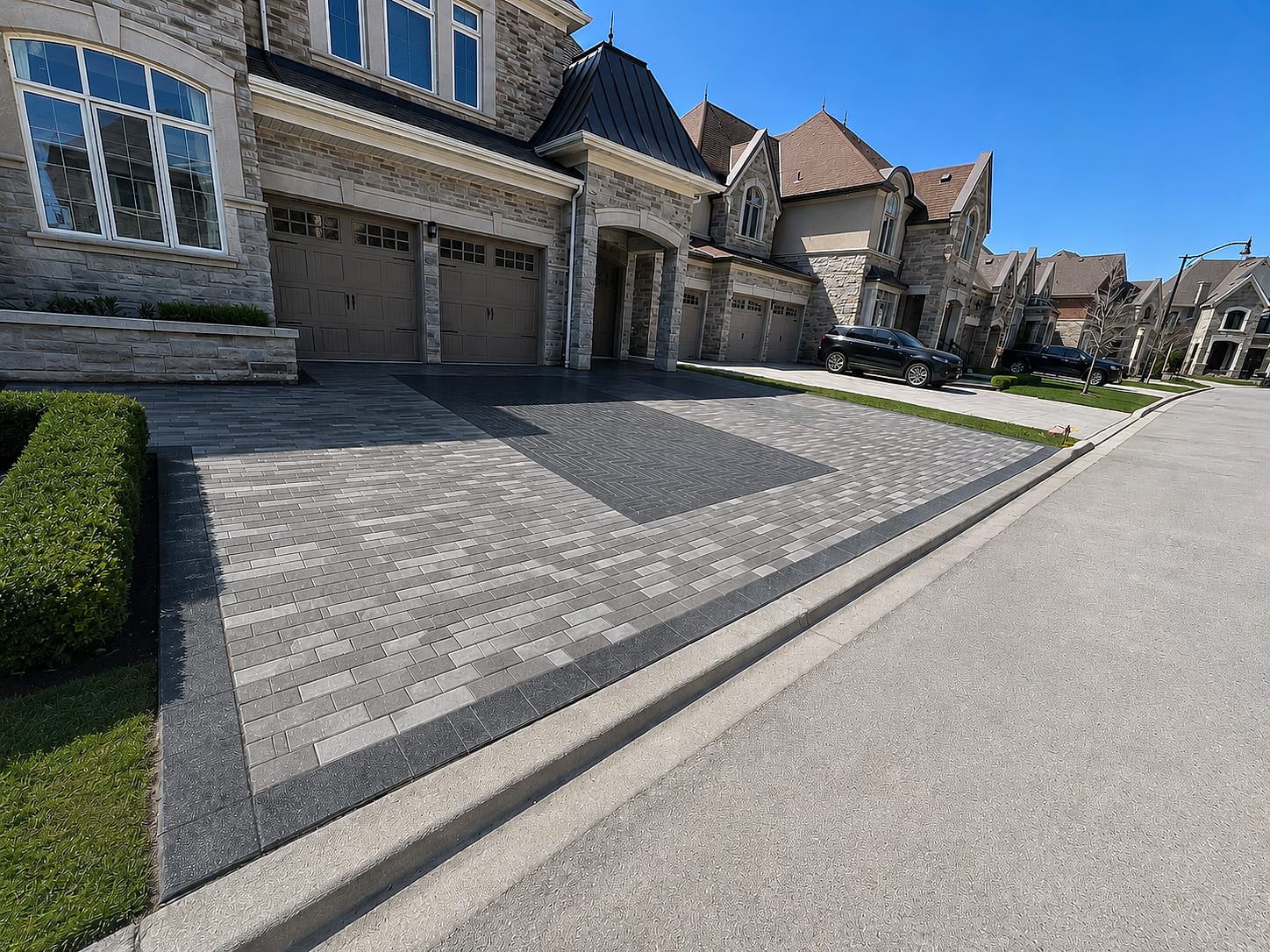
Buyer's Guide
Interlock vs Concrete Driveways in the GTA
An honest comparison from a contractor who installs both — cost, lifespan, repairs, winter performance and what it does to your curb appeal.
The Short Answer
Concrete is cheaper to install. Interlock is cheaper to own — and it is the only one of the two that still looks new after a repair.
Every GTA driveway lives through about twenty freeze-thaw cycles a year. That single fact decides this comparison. A poured slab is rigid, so when the ground moves the slab relieves the stress the only way it can — it cracks. An interlock driveway is thousands of small units on a flexible, compacted base, so it moves with the ground instead of fighting it.
That is also why the two age so differently. A crack or a scaled patch in concrete is permanent unless you replace the section, and the replacement never quite matches. Interlock is repairable unit by unit for life: lift the pavers, correct what moved underneath, put the same stones back. Nobody can tell.
Both are legitimate choices — we install both. If the budget is tight or it is a utility area, concrete is honest value. If this is the front of your home and you intend to stay, interlock wins on almost every measure that matters after year five.
 Written and reviewed by the A-Z Landscaping Design-Build Team Richmond Hill, ON12+ years · 380+ projectsUpdated June 15, 2026
At a glance
- Interlock: 30–50+ yrs, repairable for life
- Concrete: 20–30 yrs, cracks are inevitable
- Stamped: decorative, but re-seal every 2–4 yrs
- Interlock costs ~40–80% more up front
- Interlock usually wins over a 30-year horizon
Not sure which suits your property? We will tell you honestly — including when concrete is the smarter spend.
Get a Free Estimate (416) 846-5893Side by Side
Interlock vs poured concrete vs stamped concrete
The same driveway, judged on the ten things GTA homeowners actually ask us about.
| Interlock pavers | Poured concrete | Stamped concrete | |
|---|---|---|---|
| Installed cost (2026) | $20–$45+/sq ft | $12–$22/sq ft | $18–$30/sq ft |
| Typical lifespan | 30–50+ years | 20–30 years | 15–25 years |
| Freeze-thaw behaviour | Flexes with the ground — no cracking | Rigid — cracks are a matter of when | Rigid — cracks show through the pattern |
| Repairability | Lift and re-lay the affected pavers | Patch or saw-cut and replace a slab | Very hard to patch invisibly |
| Repair looks like new? | Yes — same units go back down | No — patches are visible | No — colour and pattern rarely match |
| Salt & de-icer tolerance | High (sealed joints, replaceable units) | Moderate — surface scaling is common | Lower — sealer wears, colour fades |
| Utility access (dig-ups) | Lift, dig, re-lay — near invisible | Break out and re-pour a section | Break out; pattern match is unlikely |
| Maintenance | Joint sand top-up; optional sealing | Crack filling; control-joint upkeep | Re-seal every 2–4 years to hold colour |
| Curb appeal / resale | Highest — reads as a designed feature | Utilitarian | Good when new; ages unevenly |
| Best for | Homeowners who want it to last and look bespoke | Tight budgets, secondary/utility areas | A concrete budget with a decorative look |
Ranges are 2026 GTA installed pricing and vary with size, access, base depth and material.
Why It Matters
The base decides everything — not the surface you pick
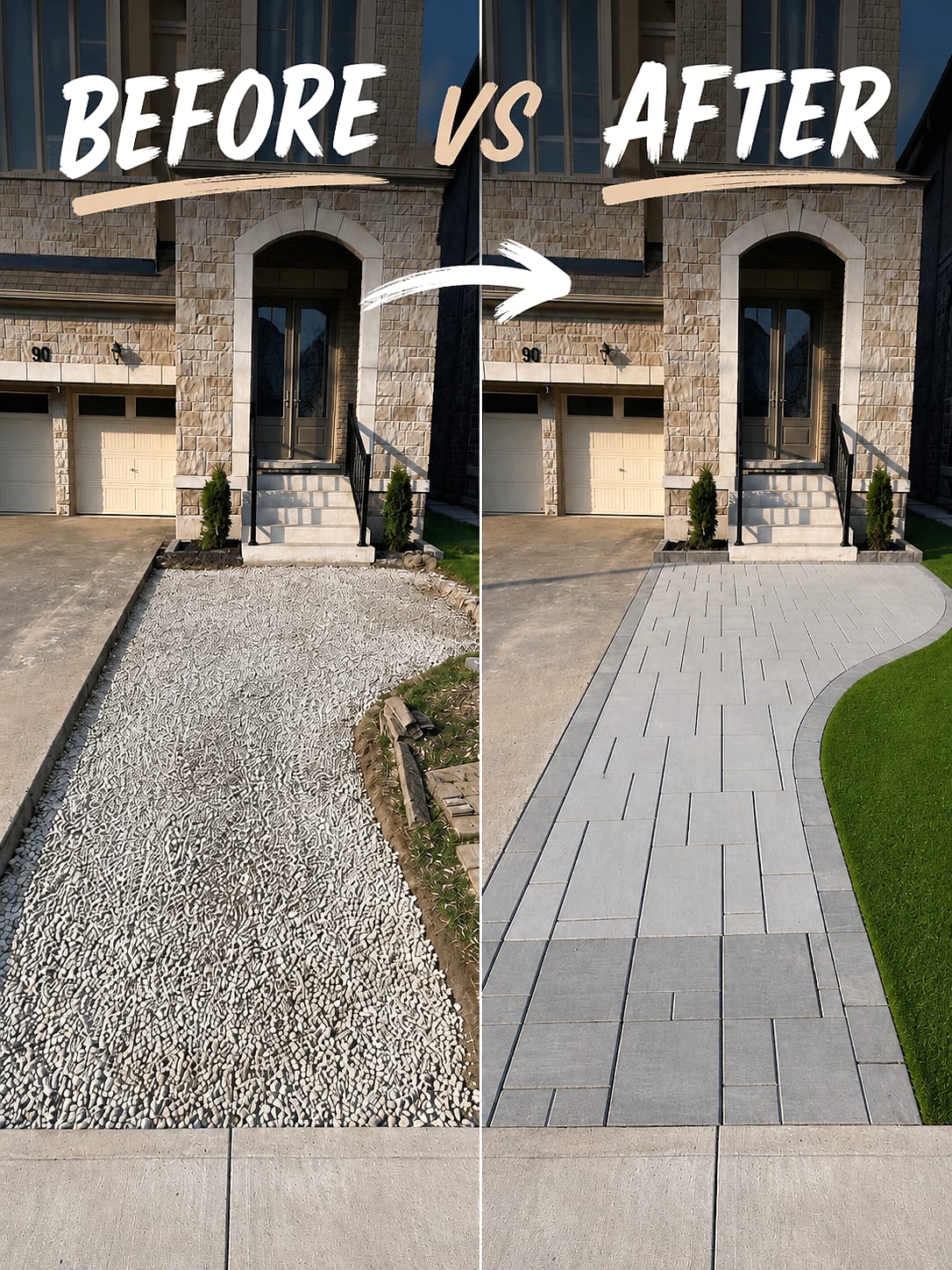
Almost every driveway failure we are called to fix — heaving interlock, cracked concrete, rutting, puddles — traces back to the same two things: a base built too thin, and water that was never given anywhere to go. The surface material gets blamed. The base is the culprit.
A driveway carries vehicle loads, not foot traffic, so it needs a load-rated depth of granular base compacted in lifts, and it needs to be pitched so meltwater leaves rather than sits and freezes. Skipping 100mm of base saves a contractor real money on quoting day and costs you the driveway in year six. This is the single most common reason a cheap quote is not cheap.
Get this right and either surface performs. Get it wrong and neither will. It is why our quotes specify excavation depth and base build-up in writing — so you can compare quotes on something other than the final number.
We cover the full pricing picture in our interlock driveway cost guide for Toronto & Vaughan, including what drives the range and where quotes hide shortcuts.
Keep Reading
Planning a driveway or patio?
Good to Know
Interlock vs concrete FAQs
Still weighing it up? Call (416) 846-5893 — we will give you a straight answer, even if it is concrete.
For most GTA homes, yes. Interlock costs roughly 40–80% more up front than plain poured concrete, but it typically lasts 30–50+ years versus 20–30, and — critically — it stays repairable for life. When a concrete driveway cracks or scales, your options are an obvious patch or a full replacement. When interlock settles or a utility has to be dug up, we lift the pavers, fix the base and re-lay the same units. The surface looks untouched. Over a 30-year horizon interlock is usually the cheaper surface, and it is the one that lifts resale value.
Eventually, yes — the question is when and how visibly. The GTA goes through roughly twenty freeze-thaw cycles a winter. Poured concrete is a rigid slab: as the ground below it heaves and settles, the slab has nowhere to go, so it relieves the stress by cracking. Good contractors manage this with proper reinforcement, correct slab depth and control joints cut where you want cracks to occur. That controls cracking; it does not eliminate it. Interlock avoids the problem entirely because thousands of small units flex independently instead of acting as one rigid plate.
Stamped concrete gives you a decorative look at closer to a concrete price, and it can look excellent the year it goes in. The trade-offs show up later: it still cracks like any slab, the crack runs straight through the pattern, it is close to impossible to patch invisibly, and the colour depends on a sealer that needs re-coating every two to four years. If you love the look and understand the maintenance, it is a legitimate choice. If you want the look to hold for decades with minimal fuss, interlock is the safer investment.
A typical residential interlock driveway runs three to seven working days depending on size, access and how much excavation is needed. Concrete pours faster — often two to three days — but then needs curing time before you can drive on it, usually about seven days. The bigger scheduling factor is the base: we excavate and compact in lifts, and we do not shortcut that stage to hit a date. You will get a firm schedule with your fixed quote.
Yes — it is one of the most common projects we do. We remove the failing surface, then fix the reason it failed, which is almost always a base that was too thin or drainage that was never addressed. Building new interlock over an old, undersized base just moves the problem. Once the grade and base are corrected we lay the pavers with borders and banding to frame the house. You can see this kind of build in our project portfolio.
Start Your Project
3D design for every driveway project
Send a few details and we'll book a free on-site visit. You'll get a photoreal 3D design and a fixed, itemized quote — no cost, no obligation.
Talk to us directly
About the author
 A-Z Landscaping Design-Build Team
We are a landscape design-build contractor operating out of 180 Brodie Dr #5 in Richmond Hill, serving Vaughan, Toronto and the wider GTA since 2014. Everything published here comes from the crews who actually dig the base, pour the footings and set the stone — not from a content agency.
Pages are reviewed by the project-management team against how we currently build and price, and the date shown on each page is when that review last happened.
More about A-ZWho wrote this, and why you can act on it
We build both interlock and poured concrete driveways across the GTA, which is why this comparison is about performance rather than preference.
- Established 2014 — 12+ years building in the GTA
- Continuously operating landscape design-build contractor working across Vaughan, Richmond Hill, Toronto, Markham and the surrounding municipalities.
- 380+ completed landscape projects
- Residential and commercial builds ranging from single driveways to full-property design-build programs, documented in our project gallery.
- 9-person in-house crew — no subcontractors
- Masons, carpenters, planters and electricians on our own payroll, so one company carries the design, the build and the warranty.
- Photoreal 3D design for every project
- Your actual house, grades and material palette modelled in three dimensions and approved by you before any excavation begins.
- Fixed, itemised quoting
- Excavation, disposal, aggregate, materials, edge restraint, drainage and restoration priced line by line — the signed number is the number you pay.
- Multi-year workmanship warranty
- Our own build is warranted by us, alongside manufacturer coverage on pavers, wall block and lighting.