 Written and reviewed by the A-Z Landscaping Design-Build Team Richmond Hill, ON12+ years · 380+ projectsUpdated June 15, 2026
What professional low-voltage landscape lighting costs in the GTA in 2026, from front-entrance packages to full estates, plus fixtures, controls and design tips.
Quick answer: A professionally designed low-voltage LED landscape lighting system in the GTA typically costs $3,500 to $8,000 for a front-yard package of about 8 to 15 fixtures, $8,000 to $20,000 for front and back yards, and $20,000 to $40,000 or more for estate properties. Installed costs usually work out to roughly $250 to $600 per fixture, depending on fixture quality, the transformer and controls, and whether cable can be run before hardscaping is finished.
Landscape lighting is one of the most cost-effective upgrades a property can have. It makes steps and paths safer, extends the hours you use your patio, discourages unwanted visitors, and shows off the architecture and landscaping you have already invested in. It is also one of the easiest things to do badly: glaring floodlights, a single row of path lights like an airport runway, or cheap fixtures that fail after two winters. This guide explains what professional landscape lighting costs in the GTA, what drives the price, and how to get a system that looks good and lasts.
Typical landscape lighting costs in 2026
| Package | Typical fixtures | Typical installed cost |
|---|---|---|
| Front entrance and walkway | 6 to 10 | $3,500 to $6,000 |
| Full front yard with facade and trees | 10 to 18 | $5,000 to $10,000 |
| Rear patio, steps and garden | 12 to 25 | $6,000 to $14,000 |
| Front and back, full property | 25 to 45 | $12,000 to $25,000 |
| Estate property | 45+ | $25,000 to $40,000+ |
These figures assume quality low-voltage LED fixtures, a properly sized transformer with a timer or smart controller, and professional design and installation. Lighting added during a larger landscape build often costs less per fixture, because cable and sleeves can be laid before the patio and walls go in.
What drives the cost
Fixture quality
Solid brass and copper fixtures cost more than aluminium or composite ones, but they do not corrode and they last for decades in Ontario's wet, salty winters. Integrated LED fixtures are compact and efficient; fixtures with replaceable LED lamps are easier to service. Cheap fixtures are the most common reason lighting systems fail after a few seasons.
Transformer and controls
Low-voltage systems run from a transformer that steps household power down to 12 volts. A quality multi-tap transformer, sized with spare capacity, allows the system to grow. Controls range from a simple photocell and timer to astronomical timers and smart controllers that let you dim and switch zones from your phone.
Number of zones
Separating the front facade, the paths, the rear patio and the garden onto different zones lets you use only what you need and set different schedules, but each zone adds wiring and control cost.
Installation conditions
Running cable through open garden beds is quick. Getting cable under an existing patio, driveway or walkway means boring or lifting pavers, which takes longer. If you are planning hardscaping, include lighting in the design so sleeves go in during construction.
The fixture types that make a good design
- Path lights mark walkways and edges. Used sparingly and staggered, they guide without the runway effect.
- Step lights are recessed into risers or walls and are the most important safety lighting on any sloped property.
- Uplights wash light up tree canopies, columns and stone facades, adding depth and drama.
- Wall wash and grazing lights bring out the texture of stone walls and veneers.
- Down lights mounted in trees or pergolas create a soft moonlight effect over patios and seating.
- Deck and in-ground lights outline decks, stairs, driveways and pool decks at low level.
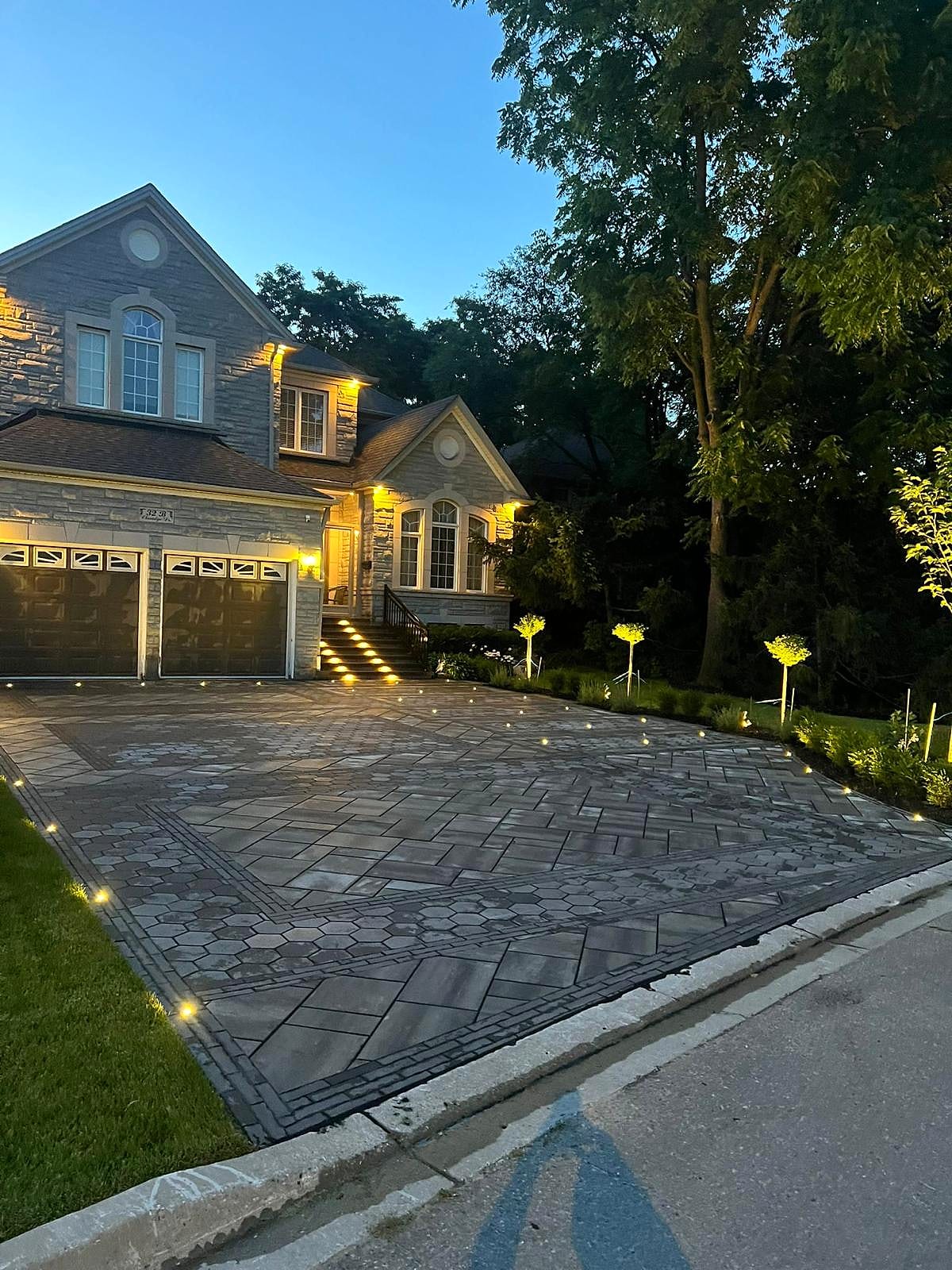
The best schemes layer several of these at low intensity rather than relying on a few bright lights. We favour warm colour temperatures, around 2700K, which flatter brick, stone and planting, and we aim fixtures to avoid glare toward the street, the neighbours and the night sky.
Safety, code and the electrical side
Low-voltage lighting is inherently safer than line-voltage systems, but the connection to household power still matters. The transformer must plug into a properly protected outdoor outlet, and any new outdoor circuit or outlet should be installed by a licensed electrical contractor. In Ontario, electrical work generally falls under the Electrical Safety Authority, which governs permits and inspections. Before any trenching, buried services should be located through Ontario One Call. We coordinate both on every lighting project.
Lighting that fits the property
Different properties need different approaches. On sloped ravine lots in York Mills and Hoggs Hollow, step and wall lighting is about safety first, with subtle uplighting on mature trees that frames the view without glaring into the ravine. Formal homes in Forest Hill and Rosedale call for symmetrical facade lighting and lit entrance steps. Modern custom homes suit linear lights in steps and walls, and backyard lighting designed around the outdoor kitchen and lounge. See our landscape lighting service for examples of how we design and build systems.
Running costs and maintenance
LED landscape lighting is inexpensive to run. A typical residential system of 20 to 30 LED fixtures draws only a few hundred watts, so even running every night it adds very little to an electricity bill. Maintenance is light: trim plants that grow over fixtures, re-aim lights after storms or snow clearing, clean lenses once a year and check connections in spring. Quality fixtures with sealed connections rarely need more.
DIY kits vs. a professional system
Big-box solar and plug-in kits are inexpensive, but they rarely produce a good result. Solar lights are dim and inconsistent in Ontario's short winter days, and cheap low-voltage kits often use undersized cable that causes lights at the end of a run to be dimmer than those near the transformer. A professional system is designed for even light levels, sized for future expansion, and built from fixtures that survive our winters. The difference shows the first evening it is switched on.
Add lighting to your landscape plan
The best time to plan lighting is during the design of a patio, driveway or backyard renovation, when cable can be sleeved under hardscape before it is finished. Your photoreal 3D design from A-Z includes a dusk view so you can see the lighting scheme before it is built. If your landscape is already finished, we can still design and install a system with minimal disruption. Lighting pairs naturally with stone steps and entrances and outdoor kitchens and fire features. Book your free consultation or call (416) 846-5893.