 Written and reviewed by the A-Z Landscaping Design-Build Team Richmond Hill, ON12+ years · 380+ projectsUpdated June 9, 2026
Porcelain, natural stone or concrete pavers? A side-by-side comparison of cost, durability, stain resistance, heat and maintenance for GTA patios, with 2026 prices.
Quick answer: For most GTA patios, concrete pavers offer the best value and are repairable unit by unit (roughly $25 to $45 per sq ft installed). Outdoor porcelain is the most stain-resistant and modern option and stays cooler around pools (roughly $35 to $60). Natural stone such as limestone or granite gives the most character and longevity (roughly $40 to $80+). All three last decades in Ontario only if they sit on a properly engineered, well-drained base.
Choosing a patio material is one of the first big decisions in any backyard project, and it shapes the look, the maintenance and the budget for decades. In the GTA the choice usually comes down to three families: concrete pavers (often called interlock), outdoor porcelain, and natural stone. Each performs well when it is installed correctly, and each has situations where it is the obvious choice. This guide compares them on the factors that matter in our climate, with real 2026 price ranges.
The three materials at a glance
| Factor | Concrete pavers | Outdoor porcelain | Natural stone |
|---|---|---|---|
| Installed cost (GTA, per sq ft) | $25 to $45 | $35 to $60 | $40 to $80+ |
| Look | Very wide range, from tumbled to sleek large-format | Crisp, modern, can mimic stone or wood | Unique natural variation, timeless |
| Stain resistance | Good, improved with sealing | Excellent, near non-porous | Varies by stone; limestone needs care |
| Freeze-thaw performance | Excellent when on a proper base | Excellent when fully supported | Excellent for granite; good for quality limestone |
| Repairability | Excellent, lift and reset individual units | Good if spare slabs are kept | Good, but matching stone can be harder |
| Heat underfoot | Moderate; dark colours get hot | Stays relatively cool, ideal for pools | Light stone stays cool |
| Maintenance | Joint sand top-up, optional sealing | Very low | Low to moderate, depending on stone |
Concrete pavers: the versatile all-rounder
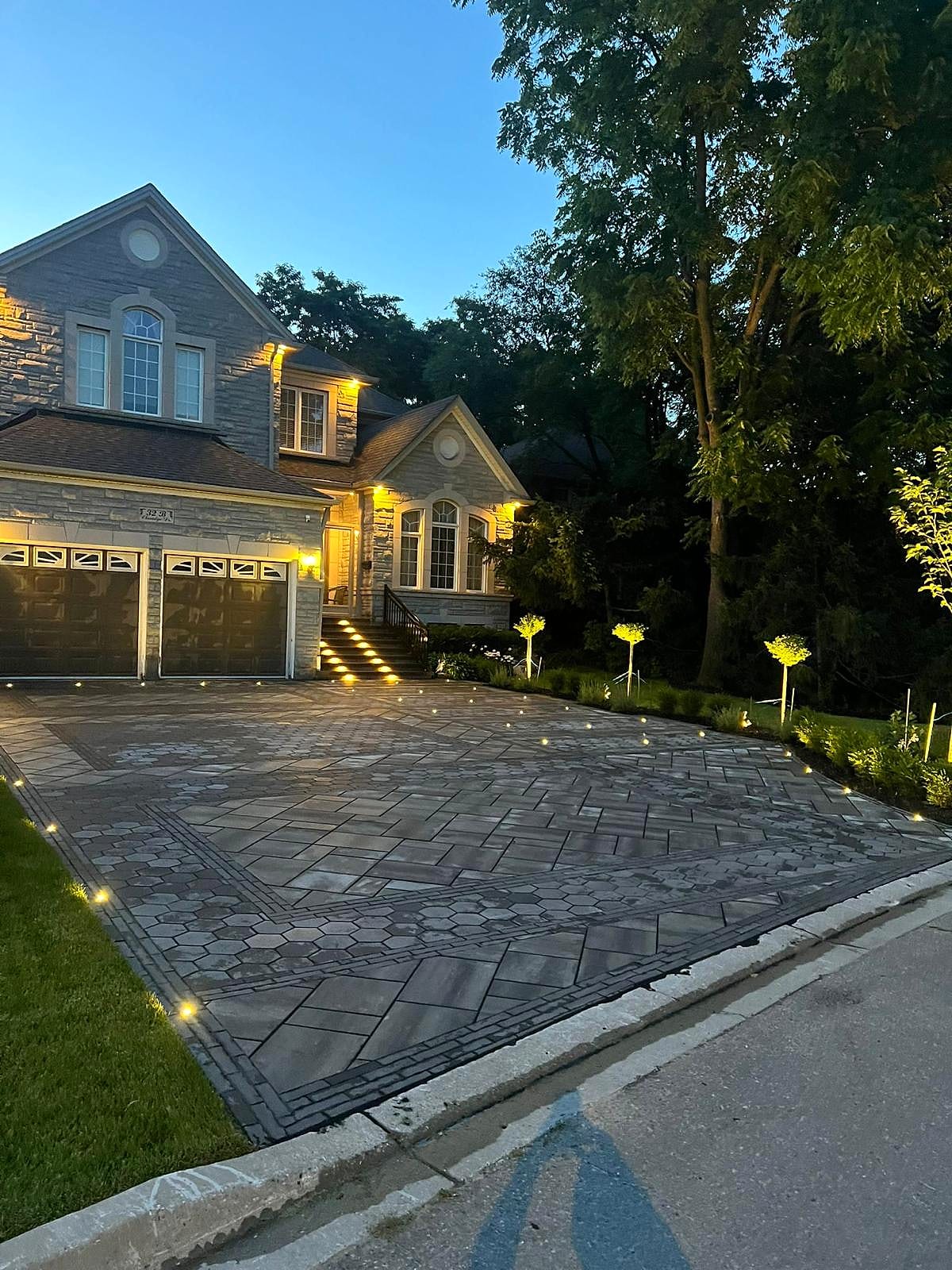
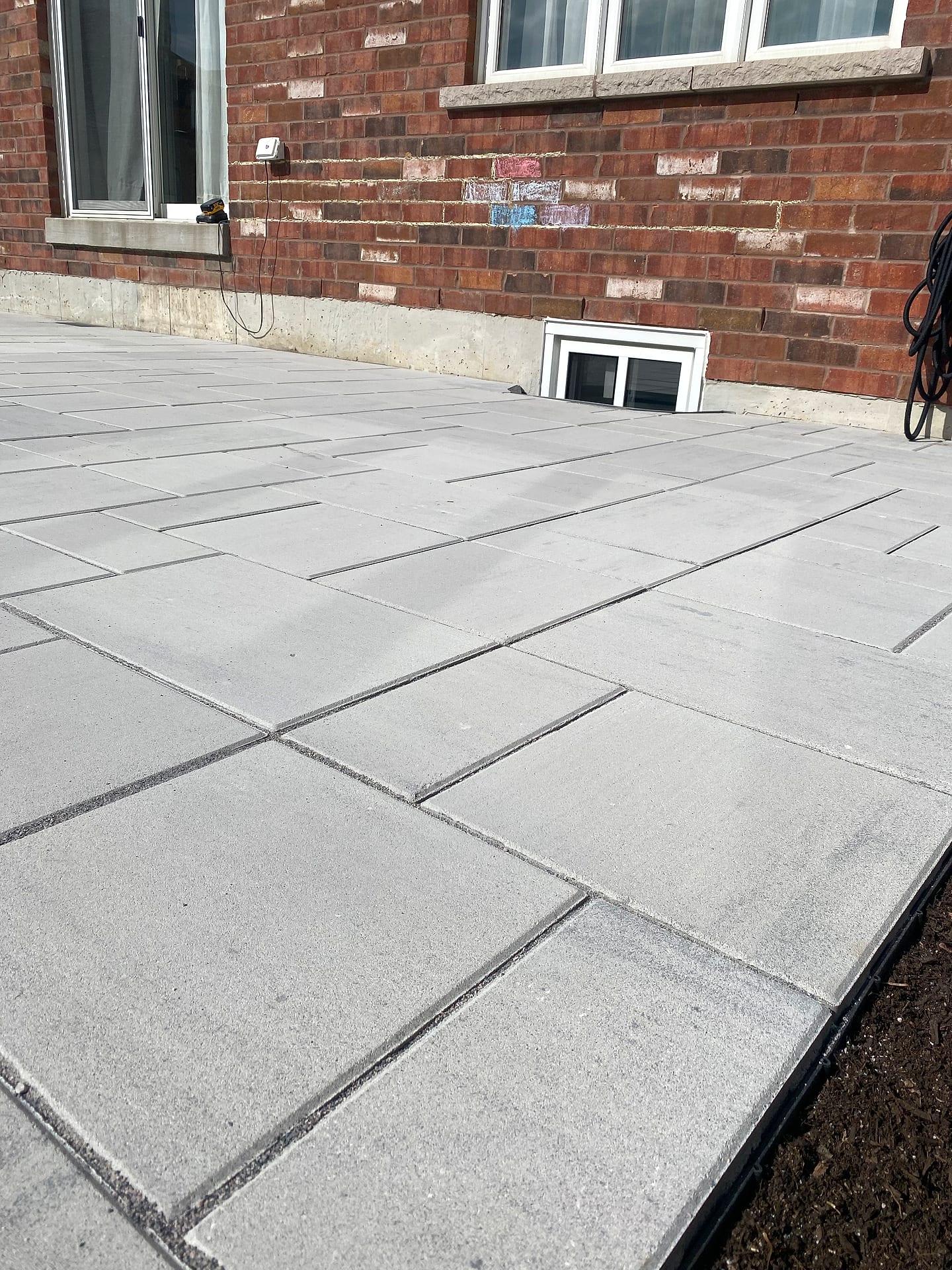
Concrete pavers from manufacturers such as Unilock, Techo-Bloc and Belgard are the most common patio surface in the GTA for good reason. They come in hundreds of shapes, sizes, colours and finishes, from tumbled cobble looks for traditional homes to large-format slabs that read almost like poured stone. Because each unit is separate and sits on a flexible base, interlock moves slightly with the ground through freeze-thaw instead of cracking, and any section can be lifted and reset without visible repairs.
The trade-offs are modest. Joints need polymeric sand and occasional top-ups, darker colours absorb heat in full sun, and some finishes benefit from sealing to resist oil and food stains. For most patios, walkways and every driveway, concrete pavers are our default recommendation. If you are choosing between brands, our comparison of Unilock vs. Techo-Bloc vs. Belgard covers the differences, and the Interlocking Concrete Pavement Institute publishes the industry installation standards we build to.
Outdoor porcelain: modern, stain-proof and cool underfoot
Outdoor porcelain pavers, typically 20 millimetres thick and often in large formats such as 600 by 1200 millimetres, have become one of the most requested materials in our patio projects. Porcelain is fired at very high temperatures, which makes it dense and close to non-porous. Wine, oil, sunscreen and barbecue grease wipe off rather than soaking in, and the surface resists chlorine and salt, which is why it is our usual recommendation around pools. Many porcelain finishes are textured for slip resistance and stay noticeably cooler underfoot than dark concrete.
Porcelain does demand precise installation. Large, thin slabs need full, even support, so the base and bedding must be flat and well compacted, and the edges must be protected from impact. It is not a driveway material unless a specific system rated for vehicles is used. It also costs more than standard pavers. When it is installed well, though, porcelain gives the cleanest contemporary look available and almost no maintenance. It is especially popular on new custom homes, such as the projects we build in Willowdale, where the patio is designed to continue the indoor floor through a walkout.
Natural stone: character that only improves with age
Natural stone covers a broad family: Indiana limestone, granite, bluestone, flagstone and others. Its appeal is that no two pieces are identical, and it suits heritage and estate homes better than any manufactured product. Granite is extremely hard and handles freeze-thaw and de-icing salt very well. Quality limestone gives a soft, refined look ideal for steps, coping and formal terraces, though it is softer and needs sensible care around acidic spills. Irregular flagstone suits relaxed, natural gardens and stepping-stone paths.
Stone is the most expensive of the three and the most demanding to install, because pieces vary in thickness and each must be set carefully. It rewards the investment with a lifespan that can exceed the house itself. The Natural Stone Institute is a useful resource on stone types and care. We use natural stone most often for front steps and entrances, pool coping and formal terraces in neighbourhoods such as Forest Hill, Rosedale and York Mills.
Which material is best for your project?
Around a pool
Porcelain or light natural stone. Both stay cooler, and porcelain shrugs off chlorine and salt. Natural limestone or granite makes excellent coping. See our pool landscaping in Vaughan page for how we detail pool decks.
A family backyard patio
Concrete pavers or large-format concrete slabs give the best balance of cost, durability and repairability, especially where a barbecue, kids and furniture will be in heavy use.
A modern custom home
Porcelain for a seamless indoor-outdoor line, or large-format concrete slabs if budget matters.
A heritage or estate home
Natural stone, at least for steps and the entrance, often paired with a quality paver on larger areas to manage cost.
A driveway
Concrete pavers rated for vehicular loads. They are proven, repairable and handle snow ploughing. Our interlock driveway cost guide covers pricing.
What a 400 sq ft patio costs in each material
For a typical 400 square foot backyard patio, including excavation, base, bedding and edge restraint, expect roughly:
- Concrete pavers: $10,000 to $18,000
- Outdoor porcelain: $14,000 to $24,000
- Natural stone: $16,000 to $32,000 or more
Steps, seat walls, lighting, drainage and difficult access are additional. For a full price breakdown, see our interlock patio cost guide.
The base decides whether any of them last
Whatever material you choose, its performance in Ontario depends on what is underneath. The GTA sees roughly twenty freeze-thaw cycles a year, and much of the region sits on clay. We excavate to the depth the soil and loading require, separate the subgrade with geotextile, compact granular in thin lifts, use a free-draining bedding layer and pitch every surface away from the house. A beautiful material on a weak base will settle and heave; an ordinary material on an excellent base will stay flat for decades.
See the materials against your own house
Samples look different outdoors next to your brick and stone than they do in a showroom. At our free consultation we bring real samples, and your photoreal 3D design shows each option on your own property before you commit. We build across the GTA, including interlocking in Richmond Hill and interlocking in Mississauga. Book your free estimate or call (416) 846-5893.