Comparison Guide
Outdoor Fireplace vs Fire Pit vs Fire Table: Cost & Best Fit for GTA Backyards
Three ways to bring fire into your backyard, compared honestly by a contractor who builds all three: what each costs in 2026, how they feel to use, and which GTA rules apply.
 Written and reviewed by the A-Z Landscaping Design-Build Team Richmond Hill, ON12+ years · 380+ projectsUpdated June 5, 2026
Outdoor fire feature costs in the GTA (2026)
| Fire feature | Typical installed cost | Fuel | Best for |
|---|---|---|---|
| Gas fire table (premium unit, installed) | $5,000 – $15,000 | Natural gas or propane | Dining or lounge terraces, pool decks, smaller yards |
| Built-in gas fire pit (stone or masonry) | $8,000 – $25,000 | Natural gas or propane | Social seating circles, sunken lounges |
| Wood-burning fire pit (where permitted) | $3,000 – $10,000 | Wood | Larger rural or estate lots outside Toronto, with a burn permit |
| Prefabricated outdoor fireplace, installed | $12,000 – $30,000 | Gas or wood | A fireplace look on a mid-range budget |
| Custom masonry outdoor fireplace | $20,000 – $60,000+ | Gas or wood | A focal point for a covered lounge or outdoor room |
Ranges include a typical gas line run and installation on a new or existing patio. Long gas runs, natural stone and structures add cost.
We build all three
Fireplaces, fire pits and fire tables are part of our outdoor kitchens and fire features service, so our advice depends on your yard, not on a product we sell.
- Compare all three in 3D on your own yard
- Licensed gas installation coordinated
- Fixed, itemized quote
- Multi-year workmanship warranty
Side by Side
How the three compare
The differences that decide how a fire feature feels to use, not just what it costs.
| Outdoor fireplace | Fire pit | Fire table | |
|---|---|---|---|
| Heat | Strongest, radiates forward to a seating group | Good, 360 degrees around the circle | Gentle, best for taking the chill off |
| Ambience | Architectural, cozy, room-like | Classic campfire gathering | Contemporary, low and sleek |
| Seating layout | Facing one direction, like a living room | In a circle around the fire | Around a table at lounge height |
| Sightlines | Tall: blocks views, adds privacy | Low: keeps views open | Low: keeps views open, ideal by pools |
| Footprint | Largest; needs a solid foundation | Medium; needs clearance around it | Smallest; works on any terrace |
| Smoke | None with gas; chimney draws with wood | None with gas; smoke with wood | None (gas only) |
| Use as a table | No | Only with a wide ledge | Yes, the ledge holds drinks and plates |
| Maintenance | Low with gas; chimney care with wood | Low with gas; ash and soot with wood | Very low |
| Toronto rules | Gas allowed; wood not permitted | Gas allowed; wood not permitted | Gas or propane, allowed |
The Short Version: Which Fire Feature Fits Which GTA Backyard
If you want a true outdoor room with a focal point, the strongest heat and some privacy, choose an outdoor fireplace. If you want the classic experience of friends sitting in a circle around the fire, choose a fire pit. If you want a contemporary look, open sightlines and a surface you can actually use for drinks and plates, choose a fire table.
In practice the decision also turns on your municipality and your lot. In the City of Toronto, wood-burning backyard fire pits are not permitted, so almost every Toronto fire feature we build runs on natural gas or propane. In Vaughan, open-air burning needs a burn permit.
On a compact midtown lot a fire table is often the only fire feature that fits comfortably, while a large Kleinburg or King City property can carry a masonry fireplace under a covered pavilion with room to spare. Budget matters too. A premium gas fire table installed on an existing patio can cost a third of a custom masonry fireplace, and both can be the right answer for different backyards.
Outdoor Fireplaces: The Architectural Anchor of an Outdoor Room
An outdoor fireplace does what a fireplace does indoors: it gives a space a focal point and organises the furniture around it. Built in natural stone, stone veneer or stucco with a raised hearth and a chimney or decorative chimney stack, it is the most architectural fire feature and the one that most changes how a backyard looks.
Because the firebox faces one direction, it radiates heat strongly toward a seating group and works beautifully at the end of a covered lounge, a pergola or a pavilion, where the roof holds warmth in on cool evenings. Its height also makes it a privacy element, blocking views from a neighbouring window or framing a corner of the yard.
The trade-offs are cost and footprint. A masonry fireplace is heavy, so it needs a reinforced foundation taken below the frost line, it takes up more space than any other option, and it blocks sightlines that you may want to keep open over a pool or a garden. With gas, the fireplace lights with a switch and leaves no ash; with wood, where permitted, it needs a proper flue and regular chimney care.
Fire Tables: Fire You Can Put a Drink On
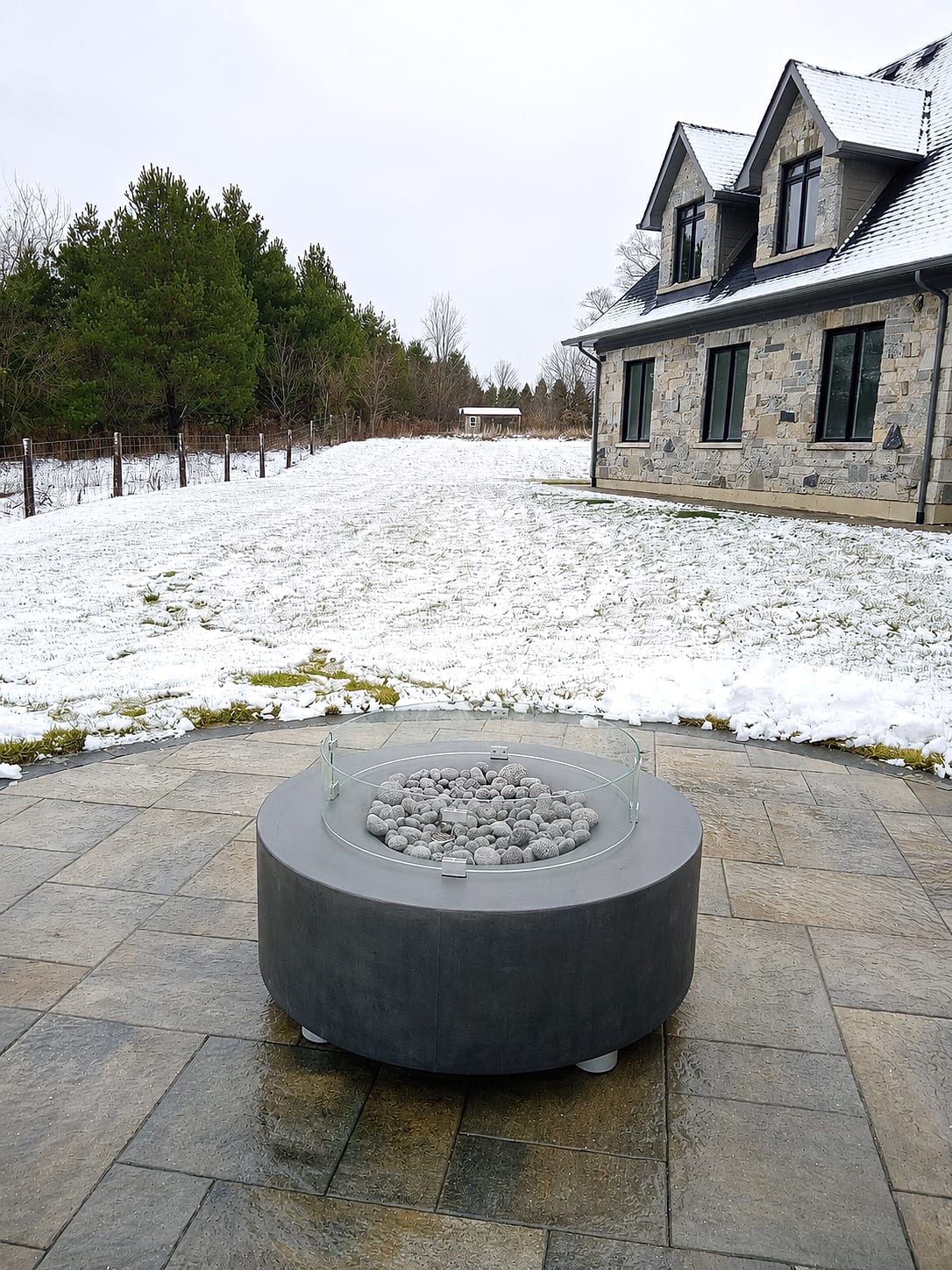
A fire table combines a gas burner with a wide ledge at coffee-table or dining height, so it is both a fire feature and a usable surface.
It is the most contemporary option and the most flexible to place: on a porcelain terrace off a modern kitchen, beside a pool where you want flame without blocking the view, or in the middle of a lounge on a compact Toronto lot where a full fire pit circle would not fit.
Fire tables run on natural gas or propane only, produce no smoke and switch off instantly, which suits close neighbours and families with young children. Premium tables are built from concrete, porcelain, stone or powder-coated steel and can be freestanding or built into a seat wall or outdoor kitchen.
The heat is gentler than a fireplace or a full fire pit, ideal for taking the chill off a September evening rather than warming a crowd in November. Because a fire table is lighter and smaller, it rarely needs a special foundation, and adding one to an existing patio is often a matter of running a gas line and setting the unit.
Wood or Gas? What Toronto, Vaughan and the GTA Allow
Fuel choice is often decided by local rules before taste. The City of Toronto does not permit wood-fuelled recreational fires, fire pits, chimineas or fire bowls in backyards.
Natural gas and propane decorative fire features are allowed without a permit, provided they are certified for outdoor use, installed and operated to the manufacturer's instructions, kept away from combustibles and supervised whenever they are lit; the City's guidance also notes that they are not intended for cooking.
In Vaughan, open-air burning requires a burn permit under the City's fire burn permit by-law, and temporary burn bans can prohibit outdoor wood-burning fire pits and fireplaces during dry spells. Rules elsewhere in the GTA differ by municipality, and some properties also have condominium or subdivision restrictions.
For these reasons the large majority of fire features we build are gas: they are permitted in more places, work during burn bans, light at the flick of a switch and never send smoke into a neighbour's yard. We confirm the current rules for your address during design.
Gas Lines, Clearances and Safety Done Properly
A gas fire feature is only as good as its installation. The gas line is run from the house to the fire feature by a licensed gas technician, sized for the appliance's rating, protected underground and sleeved beneath the patio during construction so it never has to be cut out later. In Ontario, gas work is regulated through the Technical Standards and Safety Authority, and every buried line should be located before digging.
Burners and fire tables should carry recognised safety certification for outdoor use. Clearances matter: fire features need distance from the house, fences, overhanging trees and combustible structures, and a pergola or roof over a fire feature must be designed for it, with the manufacturer's overhead clearances respected. The surround and the surface immediately around the fire should be non-combustible stone, porcelain or masonry.
Electronic ignition, a remote or app control and a wind guard on exposed sites make a gas feature easier and safer to use. We design all of this into the plan from the start, which is far cheaper than retrofitting a gas line under a finished terrace.
Placing a Fire Feature in Your Backyard Layout
Where the fire goes affects how much you use it. We look at the route from the kitchen, because a fire feature too far from the house tends to be lit less often. We look at prevailing wind, which in much of the GTA comes from the west and north-west, so seating is placed where flames and any smoke move away from guests.
We consider what the fire should frame or hide: a fireplace can screen a neighbour's window, while a low fire table keeps a pool or ravine view open. We plan seating distances so people sit close enough to feel the warmth but with room to get up and move around. And we think about the rest of the outdoor room, because fire works best paired with lighting, shade and, often, an outdoor kitchen.
In a photoreal 3D design of your actual yard you can try a fireplace, a fire pit and a fire table in the same spot, at dusk, and see which suits the space before anything is ordered. That comparison usually settles the question in minutes.
Cost Summary and Long-Term Value
In the GTA in 2026, a premium gas fire table installed with a new gas line typically costs $5,000 to $15,000, a built-in gas fire pit in stone or masonry $8,000 to $25,000, a prefabricated outdoor fireplace installed $12,000 to $30,000, and a custom masonry outdoor fireplace $20,000 to $60,000 or more.
Wood-burning fire pits cost less to build, roughly $3,000 to $10,000, but are not permitted in Toronto and need a burn permit in Vaughan. The variables that move the number are the length of the gas run from the house, the materials of the surround, whether a seat wall, hearth or chimney is included, the foundation, and whether the feature is built alongside a new patio or retrofitted into an existing one.
Built well, any of the three lasts for decades and adds weeks to the outdoor season at both ends of summer. Because every A-Z project is designed in 3D and quoted as a fixed, itemized price, you can compare all three options on your own property before you choose.
Good to Know
Fire feature FAQs
A gas fire table is usually the better choice on a compact Toronto lot. It needs the least space, doubles as a table, keeps sightlines open and produces no smoke. Wood-burning fire pits are not permitted in Toronto, and a gas fire pit needs a wider ring of clear patio around it for seating.
A prefabricated outdoor fireplace installed on a proper foundation typically costs $12,000 to $30,000. A custom masonry fireplace in natural stone with a hearth and chimney usually runs $20,000 to $60,000 or more. Gas line length, materials and whether it is built under a pergola or pavilion are the main variables.
No. The City of Toronto does not permit wood-fuelled backyard fire pits, chimineas or fire bowls. Natural gas and propane decorative fire features that are certified for outdoor use are allowed without a permit, as long as they are installed and operated to the manufacturer's instructions and supervised when lit.
For open-air burning, yes. Vaughan requires a burn permit for open-air burning under its fire burn permit by-law, and temporary burn bans can prohibit outdoor wood-burning fire features. Gas fire features avoid most of these issues. We confirm the current rules for your property during design.
Often, if it is designed for it. The fire feature's overhead and side clearances must be respected, the pergola must be built with that in mind, and gas fire tables are usually the easiest option to place under a structure. Wood-burning fire under a roof needs a fireplace with a proper chimney.
See All Three On Your Yard
Compare them in 3D before you choose
Book a free on-site visit. We will model a fireplace, a fire pit and a fire table in your actual backyard, at dusk, with a fixed, itemized quote for the one you pick.
Talk to us directly
About the author
 A-Z Landscaping Design-Build Team
We are a landscape design-build contractor operating out of 180 Brodie Dr #5 in Richmond Hill, serving Vaughan, Toronto and the wider GTA since 2014. Everything published here comes from the crews who actually dig the base, pour the footings and set the stone — not from a content agency.
Pages are reviewed by the project-management team against how we currently build and price, and the date shown on each page is when that review last happened.
More about A-ZWho wrote this, and why you can act on it
We design and build outdoor fireplaces, fire pits and fire tables across the GTA. This guide reflects what we install and the rules we work within.
- Established 2014 — 12+ years building in the GTA
- Continuously operating landscape design-build contractor working across Vaughan, Richmond Hill, Toronto, Markham and the surrounding municipalities.
- 380+ completed landscape projects
- Residential and commercial builds ranging from single driveways to full-property design-build programs, documented in our project gallery.
- 9-person in-house crew — no subcontractors
- Masons, carpenters, planters and electricians on our own payroll, so one company carries the design, the build and the warranty.
- Photoreal 3D design for every project
- Your actual house, grades and material palette modelled in three dimensions and approved by you before any excavation begins.
- Fixed, itemised quoting
- Excavation, disposal, aggregate, materials, edge restraint, drainage and restoration priced line by line — the signed number is the number you pay.
- Multi-year workmanship warranty
- Our own build is warranted by us, alongside manufacturer coverage on pavers, wall block and lighting.